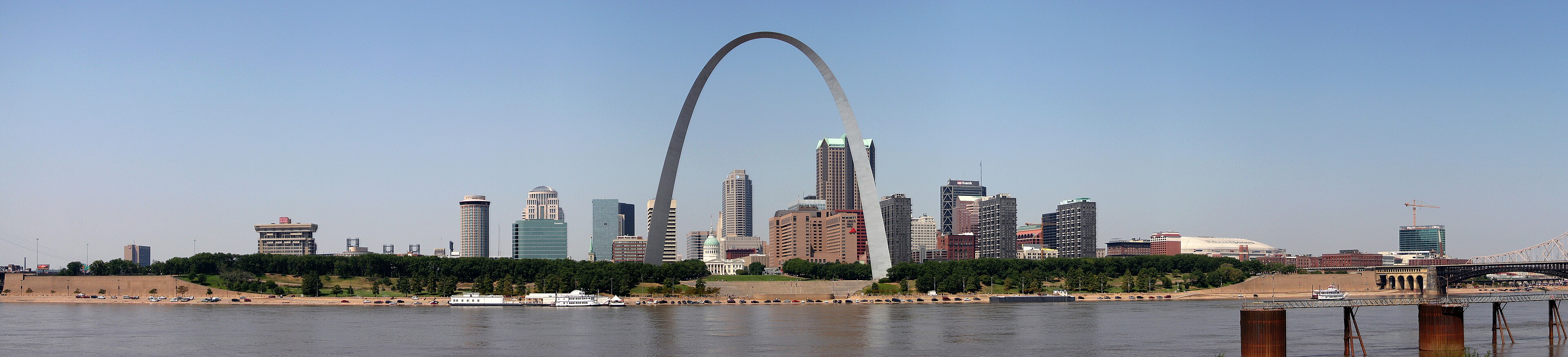
St. Louis
Missouri, USA · Downtown · the riverfront · Clayton
46 places pinned — click any one for its story.
The place
St. Louis was founded in 1764 by French fur traders on the west bank of the Mississippi, just below its meeting with the Missouri — the last supply post before a thousand miles of unmapped continent. Lewis and Clark left from here in 1804; for the next century every wagon, steamboat and railcar heading west came through. By 1900 it was the fourth-largest city in the country, and in 1904 it hosted both the World's Fair and the Olympic Games in the same park in the same summer.
What that money built is still standing, and most of it is architecture. Louis Sullivan put two of his skyscrapers here — the Wainwright in 1891 and the Union Trust in 1893 — and invented the way tall buildings would look for the next century in the process. The Union Trust is where I stayed: 705 Olive, dark and ornamented, with Sullivan's bronze elevator doors and their arched floor dials still in the lobby, now the Hotel St. Louis.
Then in 1965 the city answered all of it with Saarinen's Arch — 630 feet of stainless steel over the levee, marking the exact spot where the country stopped being a coast and started being a continent.
Places I visited
History & facts for each spot — with a “then & now” archival photo where one exists. Every one has its own page; open it for the full write-up and all the photos.
Louis Sullivan's Union Trust Building, finished in 1893 at 705 Olive — one of the handful of Sullivan skyscrapers still standing, and the second he built in this city. Terra cotta ornament runs the full height; the bronze elevator doors and their arched floor dials are still in the lobby. A 1924 remodel stripped the or…
Full history & photos →Read more on Wikipedia →Archival photo: Union Trust Building, northwest corner of Seventh and Olive. Erected 1892-93, Adler and Sullivan, and Ramsey, architects — Wikimedia Commons
Adler & Sullivan, 1891 — the building where the steel-frame tower first learned to look like one. Sullivan's 'tall office building artistically considered' in brick and terra cotta, two blocks from the Union Trust and a National Historic Landmark.
Full history & photos →Read more on Wikipedia →Archival photo: Wainwright Building, 709 Chestnut Street. Adler, Sullivan, and Ramsey, Architects — Wikimedia Commons
Eero Saarinen's 630-foot stainless steel catenary, designed in 1947, built 1963–65 — the tallest monument in the United States and the memorial to Jefferson's Louisiana Purchase and the westward expansion it opened. You get to the top in a tram nobody else has ever built: Dick Bowser drew it in two weeks in 1960, a cha…
Full history & photos →Read more on Wikipedia →Archival photo: St. Louis riverfront after demolition for Gateway Arch (1942) — Wikimedia Commons
The domed 1828 courthouse under the Arch where Dred and Harriet Scott sued for their freedom in 1846 — the case that ran to the Supreme Court in 1857 and helped push the country into civil war. Virginia Minor's suit for a woman's right to vote was filed here too.
Full history & photos →Read more on Wikipedia →Archival photo: St. Louis, MO Old Courthouse in 1862 (3400916133) — Wikimedia Commons
The block between Broadway and Sixth, Market and Chestnut, laid out so that the Old Courthouse dome and the Arch line up behind the water. Harry J. Kiener was a St. Louis businessman who ran for the United States track team at the 1904 Olympics — held here, in Forest Park, the first Games outside Europe. He died in 196…
Full history & photos →The levee below the Arch, where the city began in 1764 as a French fur-trading post and grew into the great steamboat port of the interior. The excursion boats still run the same water at sunset.
Full history & photos →Read more on Wikipedia →Archival photo: St. Louis levee looking north to Eads Bridge from Anchor Line wharf boat — Wikimedia Commons
Theodore Link's 1894 Romanesque headhouse and its Grand Hall — once the largest and busiest passenger rail terminal in the world, running 100,000 travelers a day at its peak. The trains stopped in 1978; the barrel-vaulted hall survived.
Full history & photos →Read more on Wikipedia →Archival photo: Stl-union-station — Wikimedia Commons
Opened in 1876 and half again the size of Central Park — the grounds of the 1904 Louisiana Purchase Exposition and the 1904 Olympics, the first held outside Europe. The World's Fair pavilions are gone but the Art Museum, built as the Palace of Fine Arts, stayed.
Full history & photos →Read more on Wikipedia →Archival photo: Festival Hall and the Terrace of States seen from the Grand Basin at the 1904 World's Fair — Wikimedia Commons
Begun in 1907, Byzantine domes over a Romanesque shell, and inside it the largest mosaic installation in the world — 41.5 million glass tesserae laid over 76 years by twenty different artists.
Full history & photos →Read more on Wikipedia →Bob Cassilly's 1997 invention inside the old International Shoe Company warehouse — a ten-story sculpture you climb through, welded out of salvaged bridges, chimneys, planes and the city's own demolished parts.
Full history & photos →Read more on Wikipedia →The Soulard brewery Eberhard Anheuser bought in 1860 and Adolph Busch turned into the largest in the world — red brick, the 1892 Brew House, and the Clydesdales in their stables since 1933.
Full history & photos →Read more on Wikipedia →Archival photo: Anheuser Busch Brewery Brew House and Boiler House, Ninth and Pestalozzi Streets — Wikimedia Commons
- 12
The Hill
The Italian neighborhood built by immigrants from Lombardy and Sicily who came to work the clay mines — Yogi Berra and Joe Garagiola grew up across the street from each other on Elizabeth Avenue.
Full history & photos →Read more on Wikipedia → The oldest cathedral west of the Mississippi and the first church in St. Louis — a log chapel blessed on this ground in 1770, six years after the city was founded. Bishop Rosati laid the cornerstone of the present Greek Revival stone church in 1831 and consecrated it in 1834; the Latin frieze reads DEO UNI ET TRINO. It…
Full history & photos →Read more on Wikipedia →Archival photo: The Old Cathedral, from Historical and Interesting Places of Saint Louis, 1909 — Wikimedia Commons
Eames & Young, 1913–14 — twenty storeys of light grey granite and off-white terra cotta on the northeast corner of Broadway and Olive, built for Boatmen's Bank, chartered in 1847 as the Boatmen's Saving Institution to hold the wages of Mississippi rivermen and the oldest bank west of the river. The firm cut a full Clas…
Full history & photos →Read more on Wikipedia →Archival photo: Boatmen's Bank, Broadway and Olive, northeast corner — Wikimedia Commons
Isaac S. Taylor, 1908 — thirteen storeys at 501 Olive, diagonally across Broadway from the Marquette. Taylor had just come off four years as Director of Works for the 1904 World's Fair, and he wrapped the first two floors of this one in white glazed terra cotta: caryatids standing at the piers, fleur-de-lis in the wind…
Full history & photos →Read more on Wikipedia →Archival photo: The La Salle Building as it nears completion — Wikimedia Commons
Stephen D. Hatch of New York with L. Cass Miller, begun 1885 and finished 1888 — eight storeys of red brick and terra cotta on the corner of Fourth and Olive, round-arched and Romanesque, built for the Laclede National Bank. A few years after it opened Laclede merged with Merchants National and the building took the na…
Full history & photos →Read more on Wikipedia →Archival photo: Olive Street west from Fourth — the Merchants–Laclede Building on the right — Wikimedia Commons
Eames & Young, 1896 — two storeys of limestone on the northwest corner of Fourth and Pine, Beaux-Arts and deliberately temple-like, because a trust company in 1896 was selling permanence. Cherubs, garlands and shells are carved along the frieze and around the cartouches; the round-arched windows are set in giant orders…
Full history & photos →Read more on Wikipedia →The long grey hall on Washington Avenue between Seventh and Ninth, opened in 1977 as the Cervantes Convention Center for Mayor Alfonso J. Cervantes and renamed America's Center after the 1993 expansion that added the Dome — 67,000 seats, home of the Rams from 1995 until they went back to Los Angeles in 2016. It is the…
Full history & photos →Read more on Wikipedia →411 Locust Street at Broadway, 1924, Mauran, Russell & Crowell — the head office of the Eighth Federal Reserve District, which covers parts of seven states from Arkansas to Indiana. A stripped classical block in Indiana limestone with the seals of the Reserve districts carved along the frieze and windows set deep behin…
Full history & photos →Read more on Wikipedia →615 Washington Avenue, opened April 2016 in the ground floor of a 1900s Washington Avenue block — the museum of the whole American blues tradition rather than one city's slice of it, built here because St. Louis sat at the hinge of the Delta and Chicago and every migration between them passed through. W. C. Handy publi…
Full history & photos →Read more on Wikipedia →Begun in 1875 as the Bradford-Martin Building, an Italianate commercial block by Francis D. Lee with Thomas B. Annan. At the turn of the century the D. Crawford Dry Goods Company bought it and had Weber & Groves turn it into a department store — they cut the dramatic central bay into the Washington Avenue front, with t…
Full history & photos →Read more on Wikipedia →Peabody, Stearns & Furber of Boston, 1892 — eleven storeys at 319 North Fourth Street, pink granite on the bottom two floors with SECURITY BUILDING cut in the frieze, red brick and terra cotta above, built when this was the financial district and a steel frame this tall was still a novelty in St. Louis. The arcaded two…
Full history & photos →Read more on Wikipedia →Nine square blocks of cobblestone street and cast-iron-fronted brick warehouse immediately north of the Arch — the only piece of the original riverfront that was not levelled in 1939 for the memorial. Pierre Laclède picked this bank in 1764 and sent his fourteen-year-old stepson Auguste Chouteau ahead to clear it. Most…
Full history & photos →Read more on Wikipedia →Archival photo: Christian Peper Tobacco Works, 709-727 North First Street — Wikimedia Commons
405 Washington Avenue, 1916 — the second clubhouse on this ground. The first burned on 9 March 1914 in a fire that killed thirty-four men, the worst in the city's history at the time, and took the Boatmen's Bank annex next door with it. The club, founded in 1903, rebuilt at once in Renaissance brick and terra cotta. It…
Full history & photos →Read more on Wikipedia →Archival photo: The Missouri Athletic Club after the fire of 9 March 1914 — Wikimedia Commons
Mauran, Russell & Crowell, 1913–14 — twenty-one storeys and 277 feet on the block between Sixth, Seventh, Olive and Locust, the tallest building in the city when it opened and still one of the largest by floor area. Chicago School: a steel frame in a white terra cotta grid, built jointly for the railroads' offices and…
Full history & photos →Read more on Wikipedia →Archival photo: Railway Exchange Building, 611 Olive Street — Wikimedia Commons
721 Olive Street, 1896, by Henry Ives Cobb of Chicago — the most inventive elevation downtown. Cobb ran sawtooth chevron bay windows the full height of the shaft in dark red brick and brown terra cotta, so the facade folds like a pleat and throws a different shadow every hour of the day. Two more storeys were added in…
Full history & photos →Read more on Wikipedia →815 Olive Street, built 1873–84 to designs by Alfred B. Mullett, Supervising Architect of the Treasury and the man responsible for the Old Executive Office Building in Washington, with William Appleton Potter and James G. Hill finishing it. Grey Maine granite, Second Empire, mansard roofs and a cast-iron dome frame ins…
Full history & photos →Read more on Wikipedia →Archival photo: Post Office and Custom House, the Olive Street side — Wikimedia Commons
812 Olive Street — two buildings fused into one. The Wright Building went up in 1906; Tom P. Barnett added the sixteen-storey Arcade half in 1919 and hung Gothic terra cotta over the whole thing. Behind the front runs a 400-foot skylit shopping arcade, the only one of its kind west of Cleveland. It sat empty from 1978…
Full history & photos →Read more on Wikipedia →906 Olive Street, 1903–04, Eames & Young, with their own addition in 1905–06 — the headquarters of the St. Louis–San Francisco Railway, the Frisco. Sullivanesque terra cotta, restrained where the Chemical Building is theatrical, with the railroad's own devices worked into the ornament. On the National Register; apartme…
Full history & photos →Read more on Wikipedia →Archival photo: Frisco Building, southwest corner of Ninth and Olive — Wikimedia Commons
911 Washington Avenue, 1896, Eames & Young — a nine-storey furniture warehouse and showroom in red brick and terra cotta for the Lammert company, and the anchor of the Washington Avenue loft district. This street was the garment and dry-goods trade: cast-iron storefronts, heavy timber floors, freight elevators, and blo…
Full history & photos →Read more on Wikipedia →10 North Tucker Boulevard, 1930, Klipstein & Rathmann — a fourteen-storey tower with a Greek temple set on top of it and, above that, a stepped pyramid copied from the Mausoleum at Halicarnassus, one of the seven wonders, with two cast aluminium griffins on the peak. It lines up dead centre behind the Arch in every pho…
Full history & photos →Read more on Wikipedia →1200 Market Street, begun 1891 and finished 1898 to a competition-winning design by Eckel & Mann — a direct answer to the Hôtel de Ville in Paris, in pink granite and red brick under steep green roofs and dormers. The original clock tower came down in 1936. Inside are marble and gold-trimmed corridors and a grand stair…
Full history & photos →Read more on Wikipedia →Archival photo: St. Louis City Hall — Wikimedia Commons
Tenth to Eleventh at Spruce Street, 1894–1917, Eames & Young for Samuel Cupples and Robert Brookings — a purpose-built freight complex of red granite and brick warehouses served by rail tunnels running beneath the floors, so goods went from boxcar to warehouse without touching the street. It was the most advanced distr…
Full history & photos →Read more on Wikipedia →Archival photo: Eighth and Poplar, across the Mill Creek yards to Cupples Station — Wikimedia Commons
1210 Locust Street, built 1859–67 to designs by Leopold Eidlitz — English Gothic Revival in Illinois limestone, the cathedral of the Episcopal Diocese of Missouri and one of the best preserved Gothic Revival interiors in the Midwest. The carved stone reredos behind the altar was cut in England by Harry Hems of Exeter a…
Full history & photos →Read more on Wikipedia →Archival photo: The Tower, Christ Church Cathedral — Wikimedia Commons
1301 Olive Street, 1912, Cass Gilbert — the architect of the Woolworth Building and the U.S. Supreme Court — paid for with Andrew Carnegie's money. Italian Renaissance granite outside; inside, a barrel-vaulted Great Hall modelled on the tepidarium of the Baths of Caracalla, with a coffered ceiling, and a delivery room…
Full history & photos →Read more on Wikipedia →Archival photo: St. Louis Public Library, 1301 Olive Street — Wikimedia Commons
1315 Chestnut Street, 1936–38, Mauran, Russell & Crowell — black granite piers, four heroic figures for Courage, Vision, Loyalty and Sacrifice, and an open cenotaph court in the middle with the names of the 1,075 St. Louisans killed in the First World War cut into the floor. Franklin Roosevelt laid the cornerstone in 1…
Full history & photos →Read more on Wikipedia →Archival photo: Soldiers' Memorial, Chestnut Street — Wikimedia Commons
1400 Market Street, 1934 — the opera house half of the Kiel Auditorium complex, built with New Deal money as the Municipal Auditorium. Art Deco limestone outside, a 3,100-seat auditorium inside with its original plasterwork. It went dark in 1991 when the arena half was torn down for the hockey rink, sat empty for twent…
Full history & photos →Read more on Wikipedia →Archival photo: The Municipal Auditorium (Kiel) on Market Street — Wikimedia Commons
1508 Locust Street, built 1851 — the last house standing of Lucas Place, the city's first private street and its most fashionable address. Robert Campbell, a Scots-Irish fur trader who crossed the Rockies with Jedediah Smith and outfitted the mountain-man trade out of St. Louis, bought it in 1854 and his family lived i…
Full history & photos →Read more on Wikipedia →Archival photo: Looking east on Locust Street — the old Lucas Place — from Sixteenth — Wikimedia Commons
801 Market Street — two blocks of the Gateway Mall that sat as empty grass until the Gateway Foundation turned them into a sculpture park in 2009. Twenty-four works by Serra, Bourgeois, Botero, Oldenburg, Dubuffet and others, set among rain gardens and a limestone wall that traces the line of the old Mississippi bluff.…
Full history & photos →Read more on Wikipedia →The campus gate at Cardinal and Pine, next door to Pappy's. Harris-Stowe began in 1857 as a normal school for the St. Louis Public Schools — the oldest public teacher-training institution west of the Mississippi and the twelfth oldest in the country. For a century it ran as two segregated colleges: Harris Teachers Coll…
Full history & photos →James Buchanan Eads' 1874 crossing — the first bridge over the Mississippi south of the Missouri, the longest arch bridge in the world when it opened, and the first large structure anywhere built of steel. Eads had never built a bridge; he had salvaged wrecks off the river bottom, so he knew the riverbed and sank the p…
Full history & photos →Read more on Wikipedia →Archival photo: Eads Bridge under construction, 1874 — Wikimedia Commons
The third ballpark of the name, opened 2006 — red brick and steel arches answering the buildings downtown, with the Arch framed over the outfield wall. Eleven World Series flags fly here, second only to the Yankees, and the retired numbers on Gate 1 run from Ozzie Smith to Stan Musial. The championship years are spelle…
Full history & photos →Read more on Wikipedia →Archival photo: Busch Memorial Stadium, its opening season, 1966 — Wikimedia Commons
A brick house from the 1840s on South Broadway, older than most of downtown, now the best known blues room in the city — Creole and Cajun food, live music every single night, a wall of broken-glass mosaic down the alley and a Hendrix stencil signed 'Billy the Kid' on the gable. The front door still says LEAVE YOUR ATTI…
Full history & photos →700 South Broadway, in the 1860s building on the corner — jazz and blues seven nights a week in the strip that survived when the rest of this end of downtown came down. Billy's on Broadway is next door at 701; Broadway Oyster Bar is two doors south.
Full history & photos →634 South Broadway, birthplace of Eugene Field — the newspaperman who wrote 'Wynken, Blynken and Nod' and became the children's poet of the century. His father Roswell Field was the lawyer who took the Dred Scott case into the federal courts. This is the last house standing of Walsh's Row, twelve identical 1845 townhou…
Full history & photos →Read more on Wikipedia →Archival photo: Eugene Field House, 634 South Broadway - Historic American Buildings Survey, 1942 — Wikimedia Commons
A marker on the block Busch Stadium now covers. Bernard M. Lynch, St. Louis' most notorious slave trader, ran his third pen here from 1859 to 1861, holding people for sale down the Mississippi to Memphis, Natchez and New Orleans. The Union army seized it in September 1861 and turned it into a Confederate prison. It sta…
Full history & photos →Read more on Wikipedia →
Where we ate
Salt + Smoke
St. LouisSt. Louis barbecue · The Ballpark Village room, across the plaza from Busch Stadium — burnt ends, brisket smoked over white oak, and the white cheddar cracker mac they are actually famous for, with a bourbon list longer than the menu. The only one of the city's serious barbecue houses that stays open at night, which is what put it in reach on this trip: Bogart's shuts at 7 and closes outright on Sundays and Mondays.
Protagonist Cafe
SoulardCoffee house · 1700 South Ninth Street, on the corner in Soulard — a red brick two-storey with chartreuse doors, a wrought-iron bracket sign and a detective in a flat cap peering through a magnifying glass for a logo. Seven days a week, 7am to 5pm. It sits diagonally across Ninth from Bogart's Smoke House, which is the reason most people find it.
Bogart's Smoke House
SoulardBarbecue · 1627 South Ninth Street at Lafayette Avenue, in a yellow-trimmed storefront under a brick three-storey in Soulard — the boar on the glass, a sticker-covered stop sign outside. Opened in 2011 by pitmaster Skip Steele, who had been running the pits at Pappy's, so the two are family: same dry-rub Memphis lineage, different address. Bogart's is known for the apricot-glazed and brûléed pork steak, and for closing the moment the meat runs out. Tuesday to Saturday, 10:30 to 4-ish.
Pappy's Smokehouse
MidtownMemphis-style barbecue · 3106 Olive Street, main entrance on Cardinal — dry-rubbed ribs smoked fourteen hours over apple and cherry wood, and they close when the food is gone. Opened 2008 and named for the late Jim 'Pappy' Emerson, uncle and mentor to Mike Emerson, who runs it with John Matthews, Skip Steele, Brian Scoggins and Niki Puto. The smokers sit out on the sidewalk with names painted on them — WAINO 50 for Adam Wainwright, another for Porky La Farge. Adam Richman ate here on Man v. Food in 2009 and the 'Adam Bomb' on the menu is named for him; the framed old menus on the wall are signed by Chris Rock, Hugh Jackman and Steven Jackson.
Full slab, and a combo of pulled pork and burnt endsthe full page →
The Capital Grille
ClaytonSteakhouse · The Generous Pour is The Capital Grille's summer wine event — one house's portfolio poured six glasses deep alongside dinner rather than by the bottle. The 2026 edition, Flight of Majesty, ran the Duckhorn Portfolio: Goldeneye out of Anderson Valley and the North Coast, Duckhorn out of Napa, ending on a one-time Heritage Cabernet blended from Oak Knoll and Howell Mountain fruit. Poured in the Clayton dining room, eight miles west of the Arch, on the first night of the trip.
The Generous Pour — a six-wine tasting flightthe full page →