
France
France, France · Paris · Versailles · Loire Valley
14 places pinned — click any one for its story.
The place
France has shaped the Western world out of all proportion to its size — its revolution gave the modern age its ideals of liberty and equality, and its art, food, and fashion still set the standard. Our trips have stayed in the north and center: Paris and its museums and cafés, the palace of Versailles, the Renaissance châteaux of the Loire, and the abbey-island of Mont-Saint-Michel off the Normandy coast.
Places I visited
History & facts for each spot — with a “then & now” archival photo where one exists. Every one has its own page; open it for the full write-up and all the photos.
The city everything else measures itself against — Haussmann's boulevards, the bridges over the Seine, and more of Western art hanging within a few square miles than anywhere on Earth.
Full history & photos →Read more on Wikipedia →Archival photo: The Liberation of Paris, 25 - 26 August 1944 HU66477 — Wikimedia Commons
Louis XIV's colossal 17th-century palace — the Hall of Mirrors, the formal gardens, and the seat of absolute monarchy until the Revolution.
Full history & photos →Read more on Wikipedia →Archival photo: The park of Versailles (19th-c. stereoview) — Wikimedia Commons
The largest château in the Loire — a 440-room Renaissance fantasy begun by François I in 1519, with a famous double-helix staircase attributed to Leonardo da Vinci and a roofline like a small city of towers.
Full history & photos →Read more on Wikipedia →Archival photo: Chambord – on angle (5242682428) — Wikimedia Commons
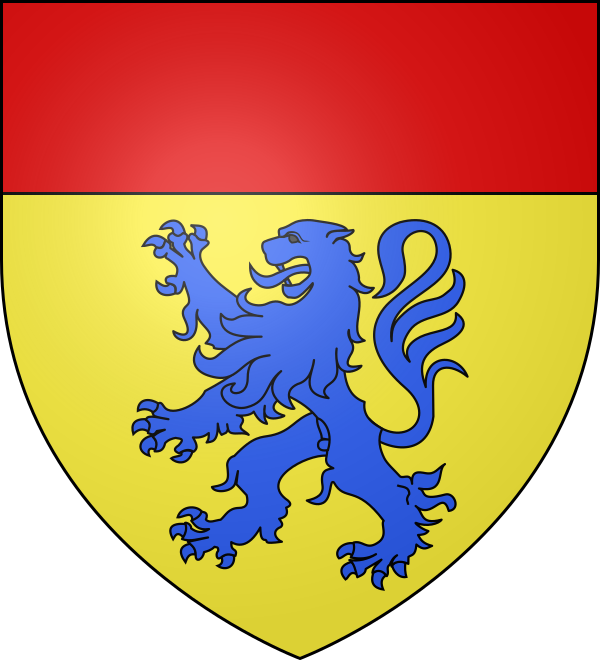
The graceful 'Ladies' Château' arching on arches right across the River Cher — built and defended by a succession of powerful women, from Diane de Poitiers to Catherine de' Medici.
Full history & photos →Read more on Wikipedia →Archival photo: Château de Chenonceau (B05) — Wikimedia Commons
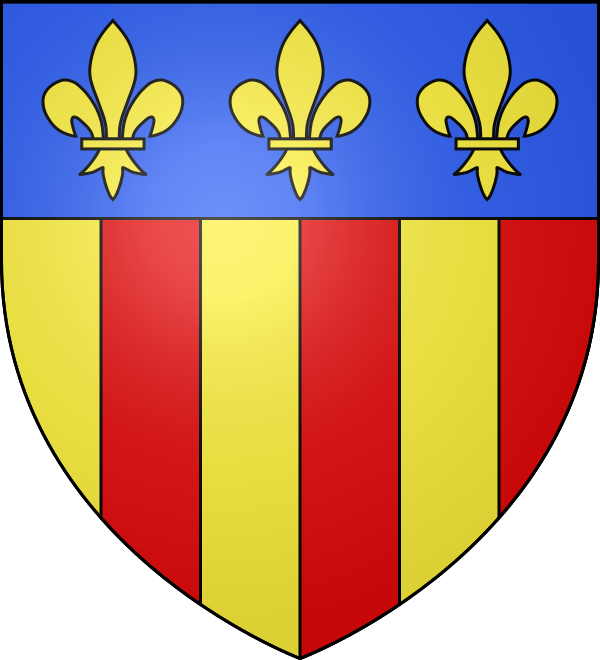
The royal château above the Loire where French kings held court — and where Leonardo da Vinci spent his last years and is buried, in the chapel of Saint-Hubert.
Full history & photos →Read more on Wikipedia →Archival photo: Gezicht op de kapel van het Château d'Amboise Amboise (Chapelle) (titel op object), RP-F-00-3846 — Wikimedia Commons
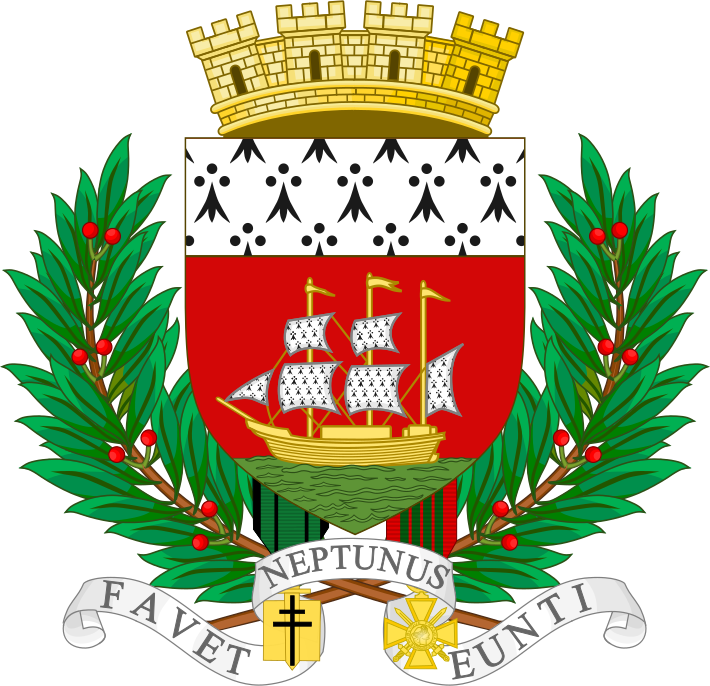
The moated castle of the Dukes of Brittany in Nantes, where the 1598 Edict of Nantes granting religious tolerance was signed — now the city's history museum.
Full history & photos →Read more on Wikipedia →Archival photo: ChateauNantesEntrance1900 — Wikimedia Commons
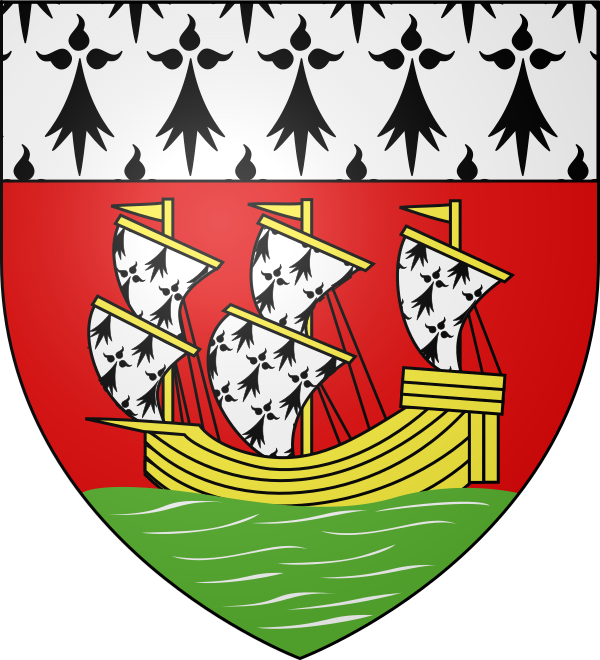
The historic capital of Brittany at the mouth of the Loire — the ducal castle, the Jules Verne connection, and the whimsical Machines de l'île.
Full history & photos →Read more on Wikipedia →Archival photo: Confluence of Erdre and Loire, Nantes, France, 1890s — Wikimedia Commons
The abbey-island rising from tidal flats off Normandy, a fortified monastery since the 8th century and one of the most dramatic silhouettes in Europe — cut off by the sea at high tide.
Full history & photos →Read more on Wikipedia →Archival photo: Mont-Saint-Michel from the water, c.1900 — Wikimedia Commons
The 1,083-foot iron tower built by Gustave Eiffel for the 1889 World's Fair — reviled at first, now the symbol of Paris and the most-visited monument on Earth.
Full history & photos →Archival photo: Eiffel Tower, full-view looking toward the Trocadero, Exposition Universal, 1900, Paris, France — Wikimedia Commons
The world's largest and most-visited museum — a former royal palace holding the Mona Lisa and the Venus de Milo, entered through I. M. Pei's glass pyramid.
Full history & photos →Archival photo: Paris-Louvre-ZI-217406 — Wikimedia Commons
The great Gothic cathedral on the Île de la Cité, begun in 1163 — its rose windows and flying buttresses, now rising again after the 2019 fire.
Full history & photos →Archival photo: Notre Dame, Paris, France, ca. 1890-1900 — Wikimedia Commons
Napoleon's triumphal arch at the top of the Champs-Élysées, honouring the armies of France, with the Tomb of the Unknown Soldier beneath.
Full history & photos →Archival photo: Arc de Triomphe de l'Etoile, Paris, France, ca. 1890-1900 — Wikimedia Commons
The white basilica crowning the Montmartre hill, above the old artists' quarter of Picasso and Toulouse-Lautrec, with all Paris at its feet.
Full history & photos →Archival photo: Rue Cortot, avec le Sacré-Coeur en construction, 18ème arrondissement, Paris. PH58389 — Wikimedia Commons
The most famous avenue in the world, running from the Place de la Concorde up to the Arc de Triomphe.
Full history & photos →Archival photo: Avenue des Champs Elysees, Paris, France, ca. 1895 (2848557102) — Wikimedia Commons